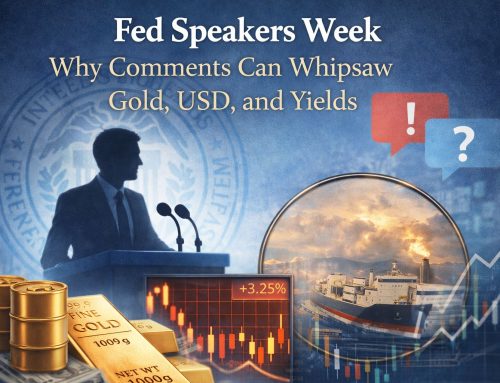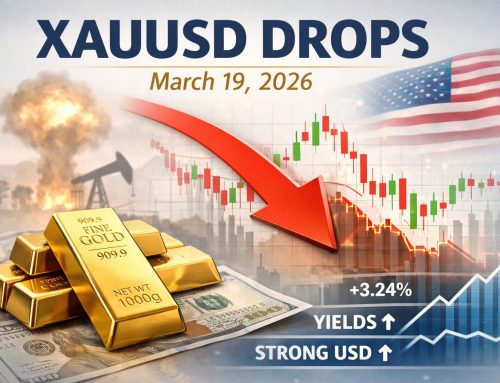
When war headlines hit—like the current U.S.–Iran–Israel escalation—markets can move in ways that feel irrational. Candles get larger, spreads widen, and price can reverse in seconds.
This article is for beginners trading gold (XAUUSD) who want a safe plan:
-
What usually happens to gold, oil, and risk markets
-
The main risks (spreads, slippage, “headline whipsaw”)
-
A simple rule-set to protect your account in aggressive markets
This is educational, not financial advice. The goal is survival first, profits second.
1) What typically happens in markets during escalation
Gold often attracts “safe-haven” demand
In periods of geopolitical stress, investors often rotate toward “safe-haven” assets (commonly including gold), which can push volatility higher.
Oil can jump fast if supply routes are threatened
Oil markets react sharply to risks around supply, shipping, and chokepoints. Recent reporting highlighted oil jumping about 10% and widespread focus on potential disruptions tied to the Strait of Hormuz, a key route for global oil flows.
Stocks can turn “risk-off,” volatility measures rise
During war shocks, indices can drop and implied volatility can rise (more uncertainty → higher hedging demand).
Beginner takeaway:
War markets don’t just “trend.” They often do: spike → trap → reverse → spike again.
2) The 5 biggest beginner risks in aggressive war markets
Risk #1: Spread widening
Your entry is worse than expected and your stop gets hit easier.
Risk #2: Slippage
Stops can fill beyond your level during fast moves (especially around breaking news).
Risk #3: Headline whipsaw
One headline pushes price up, the next headline reverses it.
Risk #4: Fake breakouts and stop hunts
Aggressive markets love obvious highs/lows—price sweeps them, then snaps back.
Risk #5: Overtrading (revenge trading)
Beginners see movement and try to “catch every candle.” That’s usually account damage.
3) Opportunities (what can work if you keep it simple)
Aggressive markets can offer:
-
Strong momentum moves (when direction becomes clear)
-
Clean liquidity-sweep reversals (after emotional spikes)
-
Better R:R setups if you wait for confirmation
But the condition is strict:
✅ Trade fewer setups, higher quality only.
❌ Do not trade “because it’s moving.”
4) Beginner safety rules for trading gold during war
Rule 1 — Cut your risk immediately
If you normally risk 1% per trade:
-
In war volatility, risk 0.25% to 0.50% max.
Why: the market can invalidate good setups randomly.
Rule 2 — No market orders in the danger zone
Prefer:
-
Limit orders at levels
-
Or wait for candle confirmation (close/hold)
Market orders during spikes are how beginners get the worst fills.
Rule 3 — Trade only in the best liquidity window
Stick to the most liquid time (London/NY overlap).
Avoid thin hours where spikes are easier.
Rule 4 — No trading during high-impact headlines
If there’s breaking news or a scheduled high-impact event:
-
either stand aside
-
or trade only after the first reaction settles and structure forms
If you’re new: don’t trade the first move. Trade the second, confirmed move.
Rule 5 — Your stop loss must be “volatility-aware”
In war conditions:
-
tight stops get harvested
-
random wicks happen
Use structure-based stops (beyond the sweep / beyond the retested level), not “tiny stops because I want big R:R.”
5) A simple “War Market Checklist” (print this)
Before any trade, you must have ALL of these:
-
I know the key levels (today’s high/low, Asia range, major S/R)
-
Spread is normal (not exploding)
-
Price is not mid-range (I’m at an edge/level)
-
Setup is confirmed (break & retest OR sweep & reclaim)
-
Risk reduced (0.25%–0.5%)
-
Clear invalidation level (where my idea is wrong)
-
I will take max 1–2 trades today, not more
If any box is missing → NO TRADE.
6) Example beginner setups that fit aggressive markets
Setup A: Sweep & Reclaim (best for war spikes)
-
Price spikes above a prior high (liquidity sweep)
-
Quickly closes back below the level
-
Retests and fails to break back up
-
Enter short with stop above the sweep high
Same logic for lows → longs.
Setup B: Break & Retest (only after volatility calms)
-
Clear break of a key level
-
Pullback retest holds
-
Enter in direction of the break
If the retest fails twice → avoid.
7) What “secure themselves” really means (beginner truth)
It doesn’t mean “find the perfect indicator.”
It means:
-
smaller risk
-
fewer trades
-
better timing
-
no chasing
-
accept that cash is a position during chaos
Survival is the strategy.