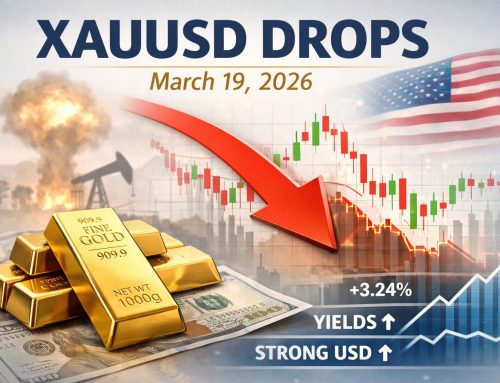
When headlines hit the Strait of Hormuz, gold traders often expect a clean “risk-off = gold up” move.
In reality, you frequently get the opposite first: violent whipsaws—a spike, a dump, then another spike—because oil shocks don’t just push “fear.” They also reprice inflation, interest rates, and the U.S. dollar, and that can yank XAUUSD in both directions within the same session.
This guide explains the chain reaction and gives you a CRT-SEM step-by-step playbook that avoids the most common trap: entering mid-range during news volatility.
1) What’s happening right now (the 60-second context)
Recent reporting describes a sharp energy shock tied to conflict escalation and disruption in/around the Strait of Hormuz, with oil surging sharply and shipping/insurance conditions worsening.
Why it matters: the Strait of Hormuz is one of the world’s most important oil chokepoints, and closing it (or even threatening it) can disrupt flows fast.
2) The real macro chain: Oil → Inflation → Rates → USD → Gold
Here’s the mechanism that creates the whipsaw:
A) Oil spikes = inflation pressure
Higher energy costs spill into transport, manufacturing, and consumer prices. Markets immediately start pricing “inflation risk.”
B) Inflation pressure = rates/yields reprice
If traders think inflation returns, they often price higher-for-longer rates (or delayed cuts). That tends to lift yields.
C) Higher yields + stronger USD can push gold down (even during war)
Gold can sell off because it offers no yield, and a stronger dollar makes gold more expensive for non-USD buyers.
D) Then “risk-off” can pull gold back up
Once the dust settles (or if risk escalates), safe-haven demand can reassert and gold can rally again.
That’s why you see “up/down/up” days.
3) The 3 traps that wipe out beginners on XAUUSD during oil shock days
Trap #1 — Trading mid-range (the chop zone)
News volatility creates wide wicks and fake breaks. If you enter in the middle of a range, you’re donating to the market.
✅ CRT-SEM rule: No mid-range entries. Only trade at edges:
-
break + retest
-
sweep + reclaim
Trap #2 — Entering before confirmation (especially on M15/H1)
During fast tape, price “looks like” it broke… and then snaps back.
✅ CRT-SEM rule: You need a candle close + acceptance (not just a wick).
Trap #3 — Confusing macro direction with entry timing
Even if the macro story supports gold, you can still lose if you buy into liquidity.
✅ CRT-SEM rule: Context gives bias. Timing gives entry. Never swap them.
4) CRT-SEM “News Volatility Mode”
Use this exactly on Hormuz / oil spike days.
A) Context (C)
-
News driver: Oil shock / shipping disruption / Hormuz risk
-
Expected behavior: whipsaw is normal; don’t predict—confirm.
-
Session: London/NY tend to move hardest on energy and USD repricing.
B) Risk Gate (R)
-
If spreads widen / wicks become extreme: reduce size or skip.
-
Only take setups where SL is logical (behind a sweep high/low), not “hope-based.”
C) Timing (T) — The only two allowed entries
1) Break + Retest
-
Break level with a close
-
Retest level
-
Hold/acceptance on the retest
2) Sweep + Reclaim
-
Liquidity sweep above/below a key level
-
Immediate reclaim with a close back inside
-
Retest confirms the reclaim
✅ If you don’t have one of these: NO TRADE.
5) A practical example (how you should read it on the chart)
Let’s say XAUUSD is ranging pre-NY. Oil headlines hit and gold starts spiking.
Scenario A: The fake breakout (most common)
-
Price wicks above resistance (everyone buys).
-
Next candle closes back under resistance (trap).
-
Price sweeps the lows and snaps back.
CRT-SEM action:
-
Do not buy the wick breakout.
-
Wait for either:
-
close above + retest hold, or
-
sweep + reclaim after a stop-run.
-
Scenario B: The clean continuation (rarer, best trade)
-
H1 closes above a major resistance.
-
Price retests the level and holds.
-
Next push forms higher low → continuation.
CRT-SEM action:
-
Entry on retest confirmation
-
SL below retest low
-
TP1 at next liquidity pool, TP2 at higher timeframe magnet
6) Exact “YES / NO” decision rule (use this during the chaos)
YES trade only if:
-
A key level is broken with a close and then retested and held, OR
-
Liquidity is swept and price reclaims with a close, then retests
NO trade if:
-
You’re entering mid-range
-
You only have a wick (no close)
-
You can’t define a clean invalidation level
If your chart doesn’t give you the structure: NO, do not enter.
7) FAQ
Why does gold fall when war headlines hit?
Because oil shocks can reprice inflation → rates → USD. A stronger USD/higher yields can temporarily pressure gold even during risk events.
Why is the Strait of Hormuz such a big deal?
It’s a major global energy chokepoint with limited alternatives; disruptions can rapidly impact oil and LNG flows.
What’s the safest way to trade XAUUSD during news volatility?
Don’t predict direction. Trade only confirmed structures: break+retest or sweep+reclaim, and avoid mid-range entries.
8) Final takeaway (the one rule that saves accounts)
On Hormuz/oil shock days, volatility is the product. Your edge is not “guessing where gold goes.”
Your edge is waiting for confirmation and trading only where risk is definable.