
Most beginners lose money with signals for one simple reason:
they treat a signal like a “buy/sell now” button.
CRT-SEM signals are different. They are structured plans built around:
Bias (direction) → Timing (session) → Setup confirmation → Risk control
In this guide you’ll learn the exact step-by-step workflow using a real CRT-SEM signal: Signal #5438 (XAUUSD, M15, Session NY).
What a CRT-SEM signal contains (you must read these first)
From Signal #5438, you can see the standard fields:
-
Market state: Sideways
-
Symbol / TF: XAUUSD · M15 · Auto H1
-
Session: NY
-
Trade levels: Entry Zone, SL, TP1/TP2/TP3
-
Lane decisions: Strict / Balanced / Scalp
-
Setup checklist: Confirmed / Failed / Waiting items (ENTRY, PD, STRUCT, etc.)
Step-by-step: How to follow a CRT-SEM signal correctly
Step 1) Read the Lane Decision first (this is your permission slip)
-
Strict: NO-TRADE
-
Balanced: WAIT
-
Scalp: WAIT
Beginner rule:
If Strict says NO-TRADE, you do not “force a trade.”
You either wait for conditions to flip, or you stand aside.
In this article we are going to provide two real setups:
- Fisrt: confirmed setup that is matching the H1 bias
- Second: A setup that is not well defined due to change of bias that is still forming
Fisrt: confirmed setup that is matching the H1 bias
Setup Real Example: Signal #5434
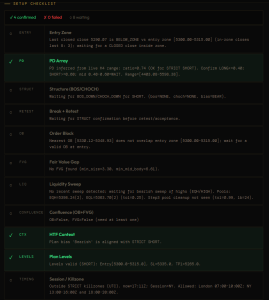
ignal #5434 is Bearish, and the HTF context says it’s aligned with strict shorts.
✅ This is what you want first: setup direction matches the higher-timeframe bias.

Step 2) Validate the plan levels (sanity check)
For a SHORT plan:
-
Entry zone must be below the stop loss
-
Targets must be below entry
Signal #5434 passes the levels validation.
✅ Entry 5300–5315, SL 5335, TP1 5265 (valid short structure).
Step 3) Respect the lane decision (permission)
Signal shows: Strict NO-TRADE, Balanced WAIT, Scalp WAIT.
This means the direction is correct, but entry conditions are not complete yet.
The exact triggers for Signal #5434
Trigger A) ENTRY trigger (must happen first)
The signal is currently waiting for an M15 candle to CLOSE inside the entry zone 5300–5315.
Right now, last close is below the zone, so it’s still WAIT.
Beginner rule:
Touching the zone is not enough. You need a closed close inside the zone.
Trigger B) STRUCT trigger (confirmation)
The signal is waiting for BOS_DOWN or CHOCH_DOWN (currently NONE).
Use it like this:
-
If price closes inside the zone, you still wait for structure confirmation before committing full risk.
Trigger C) Confluence trigger (OB/FVG OR liquidity sweep)
At the moment:
-
OB does not overlap the zone
-
No FVG found
-
No recent sweep detected; waiting for a bearish sweep of highs
-
Confluence = OB False, FVG False (need at least one)
Beginner rule:
If confluence stays missing → keep WAIT (don’t “force” the short).
Trigger D) Timing trigger (STRICT lane)
The signal notes it’s outside STRICT killzones (UTC) and lists the allowed windows:
-
London 07:00–10:00Z
-
NY 13:00–16:00Z and 18:00–20:00Z
Beginner rule:
If you’re trading the strict lane, don’t execute outside allowed windows.
Execution plan (only if triggers fire)
If you get:
-
M15 close inside 5300–5315, and
-
BOS/CHOCH down confirmation or a clean sweep/reject, and
-
at least one confluence (OB or FVG),
Then the plan is:
-
Entry: from 5300–5315 after confirmation
-
SL: 5335
-
TP ladder: 5265 → 5240 → 5210
-
Management: take partial at TP1, reduce risk, don’t move SL farther.
Second Setup: A setup that is not well defined due to change of bias that is still forming
Setup Real Example: Signal #5438

Step 2) Check the Trade Levels (Entry, SL, Targets)
Signal #5438 provides:
-
Entry Zone: 5289 – 5305
-
Stop Loss: 5275
-
TP1: 5335
-
TP2: 5365
-
TP3: 5390
✅ This gives you structure and clear planning.
But you still must pass the next step:
Step 3) Do the “Sanity Check” (levels must make sense)
Your system already flags an important issue inside the signal:
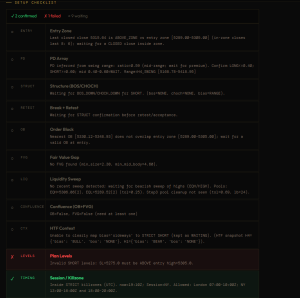
“Invalid SHORT levels: SL=5275.0 must be ABOVE entry high=5305.0.”
That’s a great example of why beginners must validate signals:
-
For a SHORT, the stop must be above the short entry zone (not below it).
-
If this sanity rule fails, the plan stays WAIT/NO-TRADE until corrected/updated.
Beginner rule:
If the signal’s own “LEVELS” check shows invalidation, do not trade it.
Step 4) ENTRY Trigger (do not enter until this happens)
Signal #5438’s entry condition is very clear:
-
The last closed price is above the zone
-
It is waiting for a CLOSED close inside the entry zone 5289–5305
Trigger = an M15 candle CLOSE inside the entry zone.
Not “touch.” Not “almost.” A close.
✅ If it closes inside → now the setup can start forming.
❌ If it stays above → do nothing. No chasing.
Step 5) PD Filter (premium/discount rule = avoid mid-range)
The signal’s PD logic shows price is mid-range (ratio ~0.59) and advises waiting for premium/discount edges.
Beginner takeaway:
When PD says “mid-range = WAIT,” do not enter from the middle of the range (this is where whipsaw kills accounts).
Step 6) Structure confirmation (BOS/CHOCH)
Signal #5438 says structure is not confirmed yet:
-
“Waiting for BOS_DOWN/CHOCH_DOWN for SHORT… (bos=NONE, choch=NONE, bias=RANGE).”
Trigger idea (simple):
-
For SHORT setups: wait for a bearish structure confirmation (BOS/CHOCH) before committing.
-
If structure remains “NONE,” stay in WAIT mode.
Step 7) Confluence filters (OB / FVG / Liquidity)
This signal shows why CRT-SEM keeps you out of low-quality trades:
-
Order Block: nearest OB does not overlap entry zone → WAIT
-
FVG: none found → WAIT
-
Liquidity sweep: none detected; waiting for sweep → WAIT
-
Confluence: OB=False, FVG=False (need at least one) → WAIT
Beginner rule:
If confluence is missing, you wait.
Signals work best when at least one confluence factor is present.
Step 8) Timing (session / killzone)
Signal #5438 notes it is inside allowed “killzones” timing.
That means: timing is acceptable, but timing alone is not an entry.
You still need entry + confirmation.
How to execute (when triggers finally fire)
If this signal flips from WAIT to actionable:
Entry method (beginner-safe)
-
Do not market buy/sell during spikes.
-
Use either:
-
Limit at the zone (only if spread is stable), or
-
Confirmation entry after reclaim/retest.
-
Stop loss
-
Place SL exactly where the plan says your idea is wrong.
-
Never move SL farther away “to give it room.”
Targets
Use the provided TP ladder:
-
TP1 5335 (take partial)
-
TP2 5365
-
TP3 5390
The “Real Signal #5438” Summary (what a beginner should do)
Based on the signal page:
Strict decision: NO TRADE.
Balanced/Scalp: WAIT until:
-
M15 candle closes inside 5289–5305
-
PD/Structure improves (avoid mid-range)
-
At least one confluence appears (OB or FVG), or a sweep/reclaim happens
-
“LEVELS” sanity is valid for the direction
If these don’t happen: NO ENTRY.