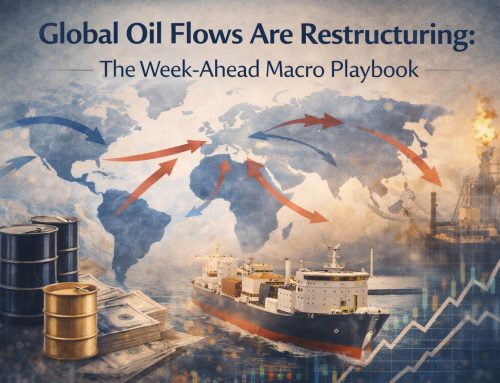
When a top-tier LNG supplier suffers a production or export shock, markets don’t just reprice “gas.” They reprice risk, inflation expectations, policy probabilities, and cross-asset correlations. In the current episode, QatarEnergy has declared force majeure on LNG exports and shut down gas liquefaction at Ras Laffan, with sources indicating a restart process that could take weeks and a minimum ~one month to return to full output once shut.
Institutional desks typically treat this as a multi-stage shock, not a one-day headline. The goal is not to “predict price,” but to map the repricing sequence and identify confirming signals versus headline noise.
What happened (and why it matters)
-
Qatar is widely described as supplying around one-fifth of global LNG exports, making it systemically important to LNG balance.
-
The disruption includes a halt to liquefaction at the Ras Laffan complex and the issuance of force majeure notices to buyers.
-
The shock is occurring in a context where shipping constraints through the region have tightened, amplifying delivery uncertainty and the risk premium embedded in prompt cargoes.
In LNG, “lost molecules” are only half the story. The other half is optionalities: cargo diversion, shipping availability, insurance, contract flexibility, and substitution (coal, oil, demand response). When those optionalities tighten, the risk premium expands faster than fundamentals alone would suggest.
The institutional Energy Shock Playbook (3 phases)
Phase 1 — Instant risk premium (hours to 2 days)
What happens: Prompt LNG and gas benchmarks react first; then freight and basis markets widen. Market participants price uncertainty before they price confirmed outages.
What to watch (confirmation signals):
-
Prompt price gaps that hold into subsequent sessions (not a one-hour spike).
-
LNG freight rates and shipping availability (a “real shock” usually pulls these up with it).
Failure mode: A sharp move that fully retraces on the first liquidity window (typical of “headline-only” risk that’s not validated by flows and logistics).
Phase 2 — Policy probability repricing (2 days to ~2 weeks)
What happens: The market starts translating energy into inflation and growth probabilities, which can shift expected central bank paths and the USD/rates complex.
In this cycle, Reuters reporting explicitly highlights how gold can be pressured by a stronger dollar and changing rate-cut expectations even when geopolitical risk is elevated—an important reminder that “risk-off” doesn’t automatically mean “gold up.”
What to watch:
-
USD direction and real-yield impulses (gold and some EM risk assets are highly sensitive).
-
Equity factor rotation (defensives vs cyclicals) and credit spreads.
Phase 3 — Second-order effects (weeks)
What happens: If the disruption persists, markets move from “probability” to “constraint.” This phase is about rationing: industrial curtailment, fuel switching, and policy interventions.
What to watch:
-
Persistent elevation in forward curves (not just spot).
-
Demand-destruction signals (industrial data, power burn changes, policy messaging).
Scenario map (how to think like a desk)
Scenario A: Rapid restart / partial normalization
If liquefaction resumes earlier than feared, the market often keeps a residual premium (because confidence recovers slowly), but spot volatility compresses.
Scenario B: Prolonged impairment / logistics remain constrained
If timelines stretch, the shock migrates from “LNG story” to “macro story,” elevating inflation uncertainty and forcing cross-asset repricing.
Scenario C: Policy intervention / coordinated shipping support
Even without new supply, policy actions can reduce the “unknowns,” lowering the risk premium faster than fundamentals would suggest.
Practical “signals that the shock is real” (not just headlines)
Institutional confirmation usually comes from alignment across three areas:
-
Physical/logistics confirmation (force majeure notices + production constraints)
-
Market structure confirmation (forward curve + basis shifts that persist)
-
Cross-asset confirmation (USD/rates + equities/credit responding coherently)
What this means for XAUUSD and risk assets (the honest version)
Energy shocks can support gold only when the channel is “risk-off + easier policy expectations” or “risk-off without a crushing USD squeeze.” But if the USD rallies hard and rate-cut expectations fade, gold can chop or pull back even as geopolitical risk stays elevated.
Institutional takeaway: On energy-shock days, gold is often a second-order trade. The USD and rates are the filter.
CRT-SEM risk note
A strict line that protects beginners:
-
NO TRADE if price is whipping inside the mid-range and spreads widen (headline liquidity).
-
Only consider trades after acceptance (close + hold) or break-and-retest on your key levels—otherwise you’re donating to volatility.
Conclusion
The Qatar LNG halt matters because it’s not a single commodity headline—it’s a system shock that can transmit into inflation expectations, policy pricing, and cross-asset correlations. Treat it as a three-phase process, demand confirmation from logistics and structure, and let USD/rates dictate whether gold is truly being bid as a hedge or simply being squeezed.